Hi. I'm Cynthia F. Kurtz.

What do you do? Participatory Narrative Inquiry.
What's PNI? People telling, listening to, and working with stories together.
What's PNI for? Insight. Understanding. Change.
What do you do again? I help you make PNI work for you.

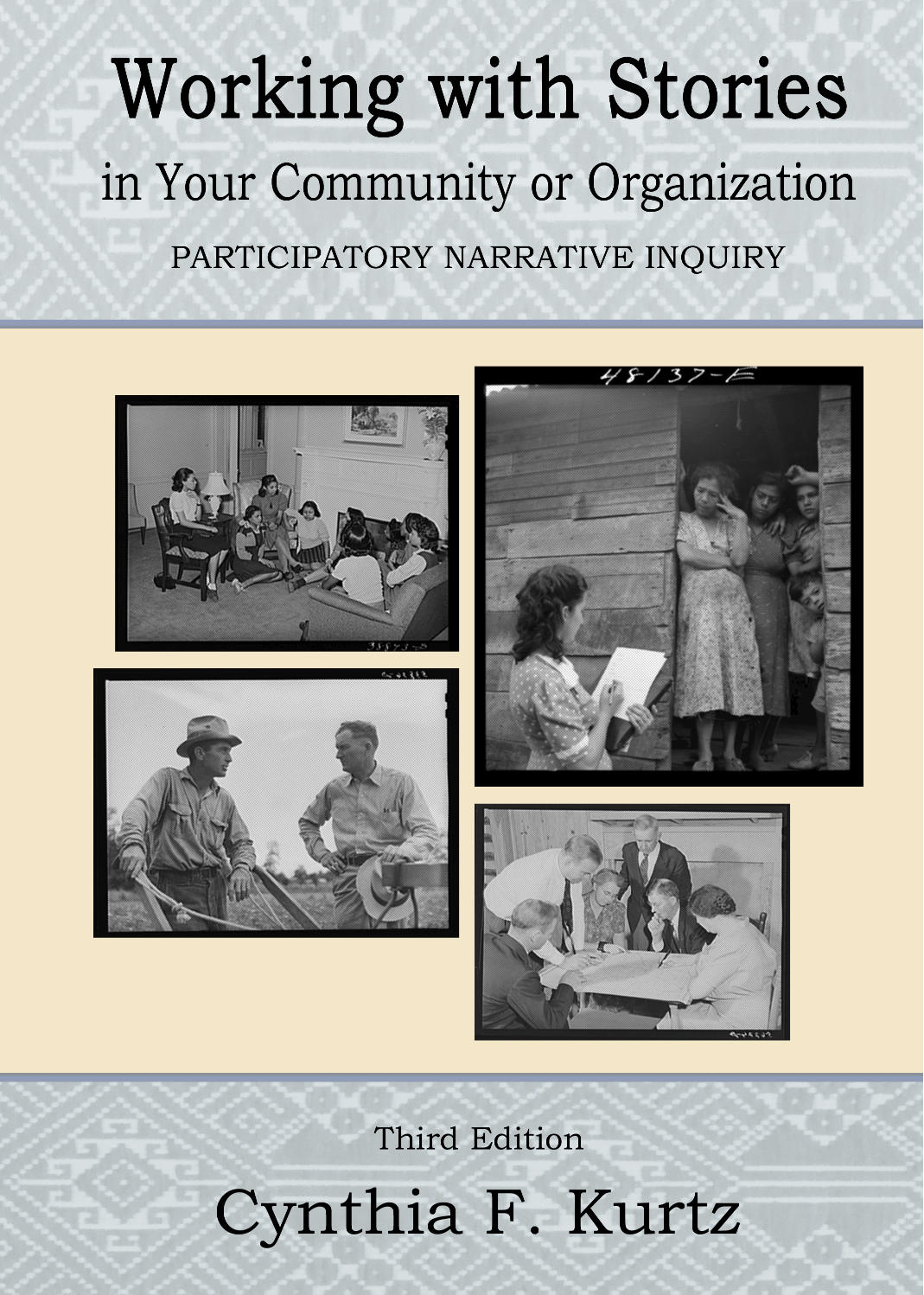
My Working with Stories book series can help you use Participatory Narrative Inquiry in your own community or organization.

Working with Stories in Your Community or Organization is the definitive textbook on the growing field of Participatory Narrative Inquiry. Now in its fourth edition, the book provides practical advice on gathering and working with the unique and valuable stories of your community or organization.

The Working with Stories book series also contains three other books:

  1. Working with Stories Simplified covers the same concepts and techniques as Working with Stories, but in much less detail.
  2. The Working with Stories Sourcebook is a reference collection of 50 question sets and 60 case studies.
  3. The Working with Stories Miscellany is a collection of 40 essays and other writings about the theory and practice of PNI.

All four books are available in three formats: PDF (for free), paperback (at Amazon), and Kindle/EPUB (at Amazon).

Read the PDF books

Buy the paperback or Kindle/EPUB books at Amazon

You can also buy the paperback books at your local bookseller. See workingwithstories.org for ISBNs.

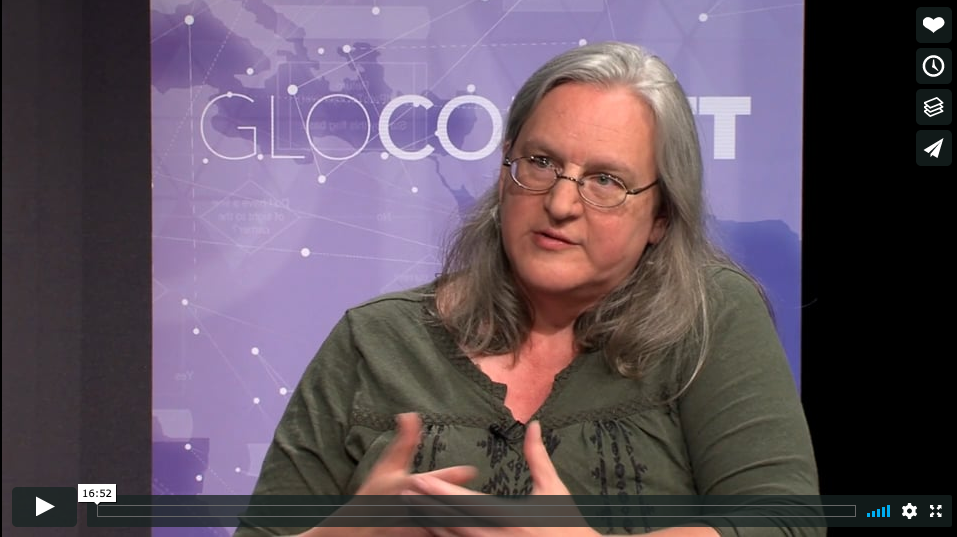
Want to see me talk about PNI?

I offer three PNI Practicum courses.

Get your start in PNI by carrying out a real-world project in a group of your peers with the aid of expert advice and support. Choose from three courses at different levels of difficulty, from beginner to advanced. Learn more at cfkurtz.com/pnipracticum.

Projects

These are just a few of the 150+ story projects I've worked on. You can find more project stories at NarraFirma.com.

Educational attitudes

A government education agency discovered that teachers were more likely than students or parents to assume that a fearful child was not trying hard enough..

Merging cultures

A big company swallowed a little company. People in both groups shared stories to understand how their two cultures could work together.

Technical know-how

A technical firm incorporated real-life stories into a learning resource that helped employees understand what getting a patent was really like.

Leadership benchmarking

A computer firm helped its executives evaluate their leadership by comparing stories about themselves with stories about other leaders, including historical ones.

These are some of the organizations I've helped with story projects. IBM. Forest Service of British Columbia. Environment Canada. Victoria State Government Department of Sustainability and Environment. International Fund for Agricultural Development (IFAD). Dutch Ministry of Education. BC Hydro. Coca-Cola. Sloan-Kettering Memorial Cancer Center. GlaxoSmithKline. Novartis. AstraZeneca. Takeda. Meridian. Tchibo. Meals on Wheels. BT. US DARPA. MINDEF Singapore. US Naval Air Systems Command. Singapore Police Force. Infocomm Development Authority of Singapore. University of California, Berkeley. University College London. Wharton University of Pennsyslvania. The Council of Professors and Heads of Computing. National Museums Liverpool. (Note that on some of these projects, I worked through intermediaries such as consulting firms.)

Consulting

I can help you in any of these ways.

Coaching

Whether you are planning a single story-sharing workshop or a year-long project, I can help you make plans, choose options, deal with problems, and improve your results. I have helped dozens of people and groups carry out successful PNI projects.

We will schedule a series of Zoom meetings at important times in your project. For example, we might meet as you frame your project, write your questions, discover patterns in your data, plan your sensemaking sessions, and work on your final report. In each meeting I will provide feedback, answer questions, and suggest ideas.

Training

If you want to learn how to use participatory narrative inquiry but don't have a project in mind, I can help you get your feet wet with a small pilot project we design and carry out together. I'm happy to train you or your group.

We will create a training project that works with your background, interests, and ambitions to build your PNI skills through step-by-step practical experiences.

Our ultimate goal will be to advance your skills to the point that you can do your own PNI projects—and develop your own PNI style—without help from me or anyone else.

Support

If you want to do PNI projects, but you don't want to handle the (completely optional) technical side of PNI—managing data, looking for patterns, building reports—I can be your back-end support person.

Once you collect your stories, you can send them to me, and I'll send you a set of catalytic material (like this one). I have done this for dozens of satisfied clients, and I can do it for you.

When I provide back-end support, I do insist on being involved (or least consulted) in writing the questions that determine the shape of the data. I can't guarantee useful material without good questions.

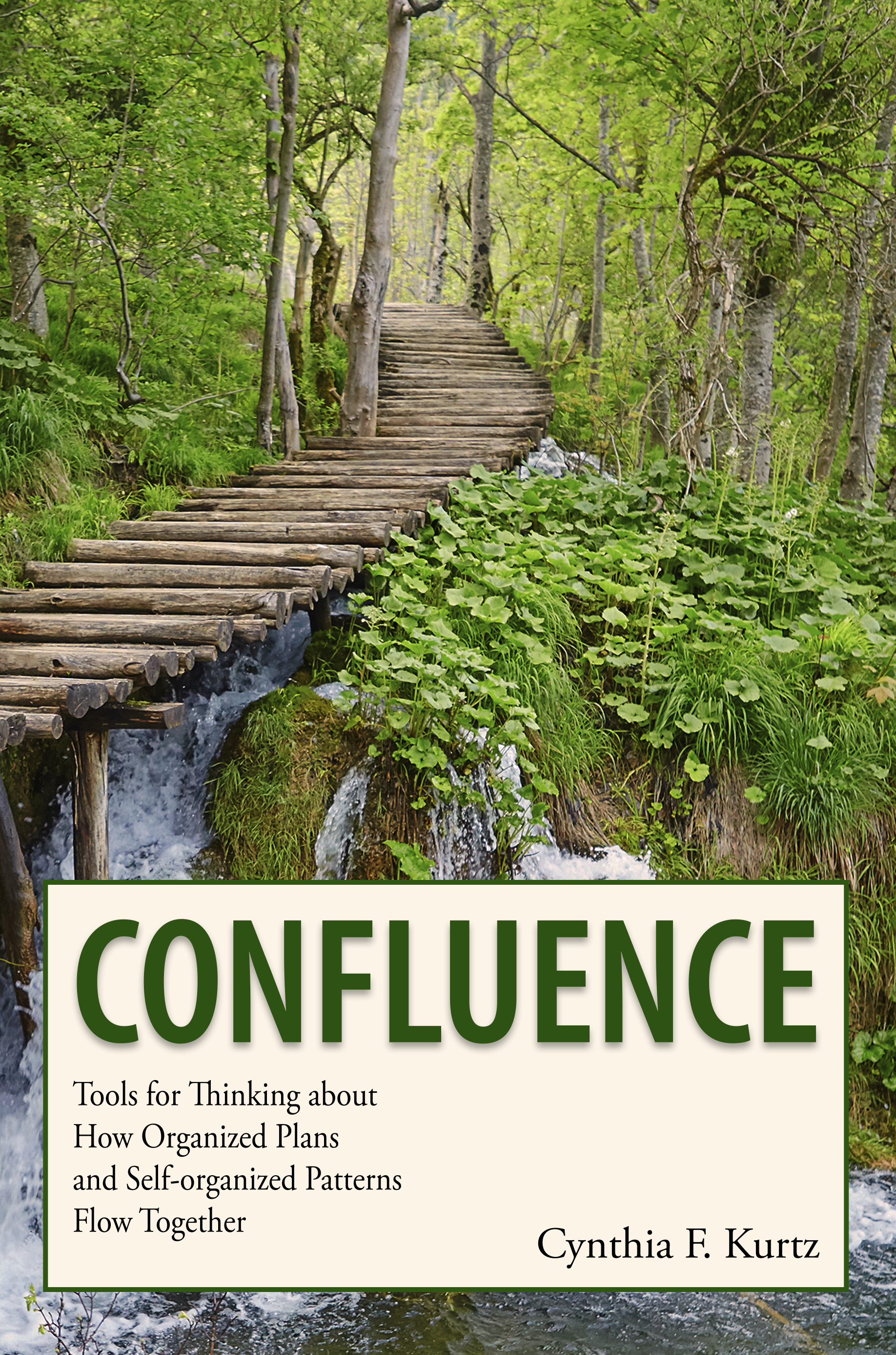
Confluence can help you work with complexity in your community or organization.

Confluence is a book about complexity as it truly exists in human lives and societies: intermingled with intentional actions. The book lays out seven thinking tools designed to help individuals and groups make sense of situations, think about how things got to be the way they are, weigh options, consider risks and opportunities, and understand differing points of view.

Buy Confluence at Amazon Go to the Confluence web site

Resources

Here are some additional publications for those who want to learn more.

Peer-reviewed papers

Other resources

White papers

Interviews

Presentations

Ancient history

For the curious

  • Fernhout, P.D. and C.F. Kurtz. 2001. A Review of Licensing and Collaborative Development with Special Attention to Design of Self-Replicating Space Habitat Systems. Proceedings of the Thirteenth SSI/Princeton Conference on Space Manufacturing, pg. 271. Slides here.
  • Ferson, S., C. Kurtz, and D. Slice. 1995. Sensitive Landscape Features for Detecting Biotic Effects of Global Change. Electric Power Research Institute (EPRI) TR-105216, Palo Alto, CA.
  • Downer, R., C. Kurtz and S. Ferson. 1992. Integration of environmental models in a geographical spreadsheet. In Computer Techniques in Environmental Studies IV, P. Zannetti (ed.), Elsevier Applied Science, London, pp. 797-804.
  • Kurtz, C.F. 1991. The evolution of information gathering: operational constraints. In From Animals to Animats, eds. Meyer, J.A. and S.W. Wilson. Proc. 1st Int. Conf. on Simulation of Adaptive Behavior, Paris, MIT Press.
  • Kurtz, C.F. 1991. The Evolution of Information Gathering: Operational Constraints. M.A. Thesis, State University of New York at Stony Brook.

Biography: where I came from.
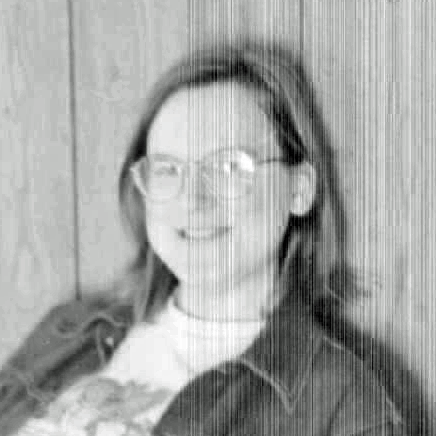
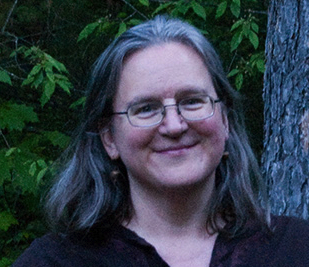
Cynthia Kurtz photo from 1992

First career: ethologist

I started my career as a biologist specializing in the evolution of social behavior. I got my B.S. in Biology in 1986 (at Clarion University), and spent five years pursuing a Ph.D. in Ecology and Evolution (at SUNY Stony Brook) before leaving in 1991 with a M.A. degree.

Second career: software designer

From 1992 to 1998, I worked on various software projects, including educational simulations of gardening and plant growth; GIS software for decision support; an organic foods database system; a payroll system; a database system for insect-host research; and a telephone interview entry system.

Third career: researcher, software designer, consultant

In 1999 and 2000 I was a "Technical Supplemental" in the Knowledge Socialization group (led by John C. Thomas) at IBM Research. I had two main research interests: finding ways to gather and work with stories to help people make sense of complex topics; and finding ways to look at stories and answers to questions about them (especially lots of them) to discover meaningful insights. The ideas behind PNI began to take shape during these two years, especially during a year-long research project on stories in e-learning, on which I collaborated with Neal Keller.

In 2001 I worked as a research consultant for the IBM Institute for Knowledge Management. At the IKM I brought my research on stories and questions together with Dave Snowden's and Sharon Darwent's work on similar topics (in IBM's Global Services division) to help clients work with stories for sensemaking and decision support. Merging our approaches, we continued to work together until 2009. During that time I assisted with the formation of the IBM Cynefin Center in 2002 and with its splitting off into the company that became Cognitive Edge. From 2003 to 2007 I was Cognitive Edge's Director of Research. In that role I researched, designed, built, supported, and refined the SenseMaker software suite. In those years we also worked together on two three-year government projects that explored ways to work with stories for decision support, conflict resolution, and future planning.

Third career plus: now with more independence!

In 2007 I established an independent consultancy practice. In 2008 I wrote the first edition of my textbook Working with Stories. In 2011 I started using the name "Participatory Narrative Inquiry" to describe the approach I continued to use and develop (and which inevitably began to diverge from the combined approach that Sharon, Dave and I had worked on together at the IKM, the IBM Cynefin Center, and Cognitive Edge).

Since that time, between consulting gigs, I have created several resources (most of them free) in my quest to help everyone learn how to use PNI in their own communities and organizations.

  • In 2014 I published the expanded third edition of Working with Stories.
  • In 2015 my husband and I released our open-source PNI project software, NarraFirma, which I have maintained ever since.
  • Also in 2015, I created a story-sharing game called Narratopia.
  • In 2021 I published my second book, Confluence, which is on complexity in human groups.
  • In 2022 I created the PNI Practicum, a set of online project-based PNI courses.
  • In 2026 I finished expanding Working with Stories into a fourth edition and a four-book series.

Frequently asked questions

  • Do you write stories?

    Participatory Narrative Inquiry is not about crafting stories, though sometimes stories are created as part of participatory processes. PNI is mostly about listening to what has happened to people. If you need help crafting stories, you can find lots of helpful people in the field of organizational storytelling (for example, I recommend Thaler Pekar and Karen Dietz).

  • How do you coach?

    I help people decide things like whom they will ask to tell stories; how, when, and where they will ask people to tell stories; what questions they will ask about the stories they collect (and the people who tell them); how they will look for and make sense of patterns; how they will facilitate sensemaking; and how they will support the return of the stories to their community or organization.

  • Do you collect stories?

    When I help people with PNI projects, I rarely collect the stories myself. Why? Because you need to find the people who will tell stories and ask them to participate. I can't do that for you. Also, anyone can collect stories. It is better for you and for your community or organization if you (and those around you) learn how to listen to stories yourself. If there is some reason why you really can't collect stories yourself, I can help; but things usually work out better when my clients collect their own stories.

  • What is narrative catalysis?

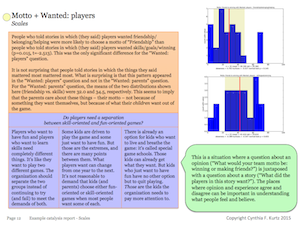
    Catalysis report thumbnail

    Narrative catalysis is a form of mixed-methods research that considers all of the data collected in a PNI project: stories, answers to questions about stories, and answers to questions about project participants. The result is a set of catalytic material: patterns, observations, interpretations, ideas, and questions. Here is an example of some catalytic material I created for a real project. In a sensemaking workshop, in addition to working with the collected stories, participants work with catalytic material to explore and discuss the project's topic more deeply than they can by working with the stories alone. I can build catalytic material for you, and I can help you learn how to build catalytic material yourself.

  • Stories and complexity?

    Yes. All complex patterns emerge over time, which means they have (or are) stories. And all stories move and spread in complex patterns in human groups and societies. So it makes sense that stories and complexity go hand in hand. I help people work with complex patterns by sharing and making sense of stories; and I help people work with stories by creating conditions under which complex patterns are likely to emerge.

  • What about software?

    I use NarraFirma, the open source PNI framework developed by my husband and myself. NarraFirma is a web application, so I use it to collaborate with clients through the internet. NarraFirma also helps us to keep a detailed record of the project for use in future projects.

  • Where are you located?

    In the US, in upstate New York, about an hour and a half Northwest of Albany. In the summer there are blackflies and mosquitoes. In the winter there is deep snow. The trees are beautiful in September.

  • How can I get in contact?

    Send an email to cfkurtz@cfkurtz.com. If you like, we can arrange a time to talk on Zoom.